

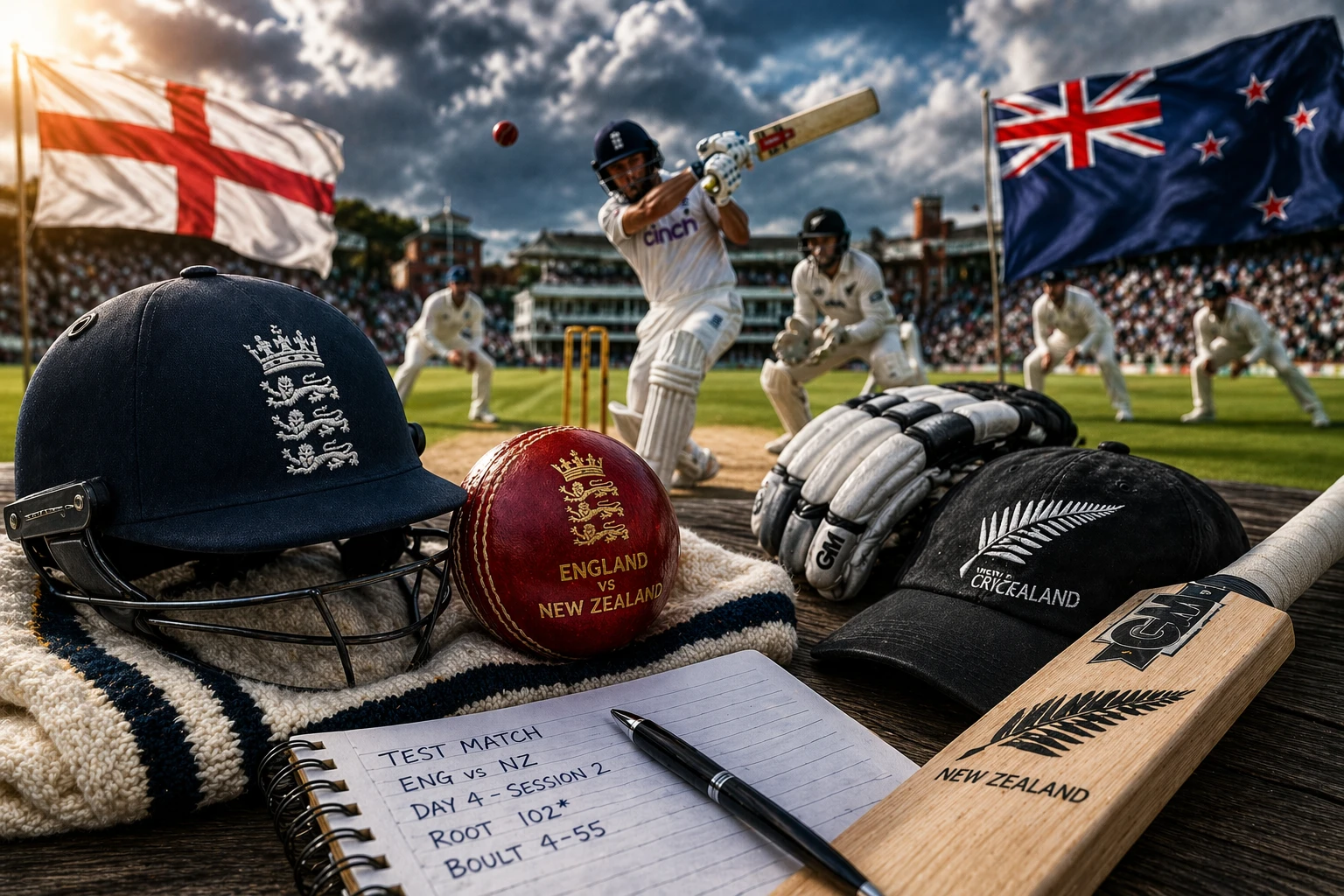
You know what? There is something incredibly special about watching England play New Zealand in cricket. Even if you are sitting here in Australia. We love to watch the old enemy take on our neighbours from across the ditch.
It is a completely different vibe compared to the Ashes. When the Poms and the Kiwis go at it, it is usually a clash of pure styles. You have the loud, aggressive English setup against the quiet, hard-working New Zealanders.
But depending on where they are playing, the time zones can be an absolute nightmare for us Aussies. If they are playing at Lord’s, you are staying up until 3 AM. You fall asleep on the couch with the television on.
Then you wake up at sunrise, grab your phone, and immediately refresh the scorecard. Honestly, that digital screen tells you everything you need to know about what happened while you were dreaming.
If you are trying to make sense of the England cricket team vs New Zealand national cricket team match scorecard, it can look a bit overwhelming. There are numbers, acronyms, and strike rates everywhere.
But do not worry. I am going to show you exactly how to read it. We will break down the batters, the bowlers, and all those little hidden stats. You will be reading it like a pro by the next test match.
The Story Behind the Numbers
A cricket scorecard is not just a math spreadsheet. It is a timeline of human pressure. It shows you exactly who stood up when things got tough, and who cracked under the heat.
When you look at a match between these two specific countries, you are looking for momentum swings. England loves to attack these days. They play fast. New Zealand loves to grind it out. They build pressure slowly.
The scorecard captures this clash perfectly. You just need to know where to look. Let’s start with the top half of the screen. The batting card.
Reading the Batting Order
The first thing you see is the batting lineup. It usually goes from number one down to number eleven. The guys at the top are the specialists. The guys at the bottom are usually the fast bowlers hoping they do not have to bat for long.
Here is an example of what a typical top-order scorecard looks like when England is batting against the swinging ball.
| Batter | Status | Runs | Balls | 4s | 6s | Strike Rate |
|---|---|---|---|---|---|---|
| Z. Crawley | c Latham b Southee | 45 | 50 | 6 | 0 | 90.00 |
| B. Duckett | lbw b Henry | 12 | 18 | 2 | 0 | 66.66 |
| O. Pope | c Mitchell b Boult | 88 | 112 | 10 | 1 | 78.57 |
| J. Root | not out | 102 | 185 | 11 | 0 | 55.13 |
Look at that table. It tells a massive story. The Status column tells you how their innings ended. If it says c Latham b Southee, it means Tom Latham caught the ball, and Tim Southee was the guy bowling it.
If you see lbw, that means leg before wicket. The batter missed the ball entirely, it hit their leg pads, and the umpire decided it was hitting the stumps. A tough way to go.
Then you look at the runs and the balls faced. Look at Joe Root in that example. He scored 102 runs, but he faced 185 balls. He was out there for hours. He absorbed all the pressure from the Kiwi fast bowlers.
Why Strike Rates Tell the Truth
We need to talk about strike rates. The strike rate tells you how many runs a batter is scoring per 100 balls. It shows you their exact tempo.
In limited-overs cricket, like T20s, you want a strike rate of 140 or more. You need boundaries. But in a five-day test match, the strike rate tells you how the team is approaching the game.
When England plays their aggressive style, you might see guys with strike rates of 80 or 90 in a test match. They are taking huge risks. They want to score fast and intimidate the New Zealand bowlers.
But then you look at a classic Kiwi batter. They might have a strike rate of 45. They do not care about looking flashy. They just want to survive the new ball and tire the English bowlers out. The scorecard shows you these two different philosophies sitting right next to each other.
The Hard Yakka: Bowling Stats
Batters get the centuries, but bowlers actually win the matches. When you scroll past the batting list, you hit the bowling figures. This is where you see who did the real hard work.
Bowling to an English batting lineup on a flat pitch is exhausting. Here is how you read the numbers they produce.
| Bowler | Overs | Maidens | Runs | Wickets | Economy |
|---|---|---|---|---|---|
| T. Southee | 22.0 | 5 | 65 | 3 | 2.95 |
| M. Henry | 18.5 | 3 | 72 | 2 | 3.82 |
| T. Boult | 20.0 | 6 | 55 | 4 | 2.75 |
| M. Santner | 15.0 | 1 | 60 | 0 | 4.00 |
Let’s break this down simply. An over is a set of six legal deliveries. A bowler bowls one over from one end, then rests while his mate bowls from the other end.
Maidens are absolute gold. A maiden is an over where the batter could not score a single run. Look at Trent Boult there. Six maidens out of 20 overs. That means for 36 deliveries, the English batters were completely stuck. That builds massive frustration.
Runs are how many runs the bowler gave away. Wickets are the prize. And the economy rate is the average runs given up per over.
An economy rate under 3.00 is brilliant in test cricket. It means the bowler is giving nothing away. It forces the batter to take a stupid risk, which usually leads to a catch in the slips.
The Hidden Match Killers: Extras
There is a small line on the scorecard that can completely change the result of a match. It is called the extras column. These are free runs given to the batting team.
In a tight game between England and New Zealand, extras can be the difference between a win and a painful loss. Here is what you are looking at.
- No-balls: The bowler stepped over the line. The batting team gets a run, and the bowler has to bowl it again.
- Wides: The ball was bowled too far down the leg side or off side. Another free run and an extra ball.
- Byes: The batter missed the ball, but the wicketkeeper also fumbled it, letting the batters run.
- Leg Byes: The ball hit the batter on the pads and rolled away into gaps, allowing a quick run.
If you see a scorecard where England bowled 20 no-balls in an innings, you know they were struggling with their rhythm. It is a sign of poor discipline. The extras column never lies.
The Panic Station: Fall of Wickets
This is easily the most dramatic part of the scorecard. It is called the Fall of Wickets. You will usually see it written as FOW on your phone app.
The FOW shows the team’s total score at the exact moment a batter got out. It tells you if they built solid partnerships, or if they panicked and collapsed.
Imagine checking your phone and seeing England at 2 for 150. You think they are cruising. Then you look at the FOW line.
It reads 1-50, 2-150, 3-152, 4-155, 5-160. That is a total collapse. They lost four wickets for just ten runs. When you see numbers bunched up like that, you know the New Zealand bowlers suddenly found some magic swing.
It means the crowd went quiet, the new batters were terrified, and the momentum completely flipped in the space of twenty minutes.
The Toss and The Pitch
Right at the top of the app, there is usually a small line of text. It says something like “New Zealand won the toss and elected to bowl.” Do not ignore this.
The toss dictates the entire match. And it depends entirely on what the pitch looks like. The numbers on the scorecard are heavily influenced by the dirt they are playing on.
- The Green Top: If there is live grass on the pitch, the ball will swing around corners. The fast bowlers will have a field day. Expect low scores.
- The Flat Track: The pitch looks like a concrete road. The batters will score centuries easily. You will see massive run totals on the board.
- The Dust Bowl: By day four or five, the pitch dries out and cracks open. The spin bowlers become deadly as the ball bounces unpredictably.
If New Zealand wins the toss on a green top in Wellington, they will bowl first every single time. They want to use those conditions to rip through the English top order.
Fielding Stats and Screamers
We spend so much time looking at the guys holding the bat and the ball. But fielding is where matches are saved. The scorecard quietly honours the guys out on the boundary.
Every time a catch is taken, that fielder’s name is recorded forever. If you see Ben Stokes listed three times in the dismissals column, you know he was flying around the field taking absolute screamers.
The wicketkeepers are always busy. Guys like Jonny Bairstow or Tom Blundell take the edges off the fast bowlers. They execute the stumpings when a batter steps too far out of their crease.
Run outs are also listed clearly. A direct hit from the outfield can change the entire mood of the stadium. The scorecard tells you exactly who had the golden arm that day.
Weather Delays and The DLS Method
You cannot talk about England playing cricket without talking about the rain. It is just a fact of life. The weather can absolutely ruin a beautiful scorecard.
If you see Match drawn at the top, and they only bowled 50 overs over five days, you know the rain washed it out. It is incredibly frustrating for the fans.
But in limited-overs matches, like One Day Internationals, they use the DLS method. This stands for Duckworth-Lewis-Stern. It is a complicated math formula used to adjust the target score when rain stops play.
- It looks at how many overs are left to play.
- It looks at how many wickets the batting team still has in hand.
- It spits out a revised target that usually confuses everyone at the pub.
If it starts raining, your app will usually show a Par Score. This is the exact number of runs the batting team needs to have right now to win if the match is officially called off. It creates a frantic panic on the field.
The Captains Brain on Paper
A good scorecard also shows you how the captains are thinking. It reveals their tactics without them saying a word.
If the English captain sets an aggressive field with four guys in the slips, he wants wickets. He does not care if the batters hit a few boundaries. You will see this reflected in a high economy rate for the bowlers, but regular wickets falling.
If the New Zealand captain wants to dry up the runs, he puts fielders out on the boundary. The batters can only score singles. You will see the strike rates drop down. The scorecard shows you this chess match in real-time.
Following the Game from the Pub
We have all been there. You are at the pub with your mates on a Saturday afternoon. You missed the first session of play. You grab a drink, look at the television, and try to catch up.
The scorecard on the screen gives you the entire context in five seconds. You do not need to ask who is winning.
You look at the runs, the wickets down, and who is still waiting in the shed. If England is 5 for 120, you know they are in massive trouble. If they are 2 for 300, you know the Kiwi bowlers are having a miserable day.
It is the universal language of the sport. You just need a quick glance to know exactly how you should be feeling about the game.
The Digital Evolution
Years ago, we used to score these games in massive paper books. The local club scorer would sit there with coloured pens for hours. Some blokes still do it, and it is a real art form.
But now, the digital scorecards on our phones are incredible. They give us so much data.
You can click a button and see a wagon wheel. It shows exactly where a batter hit every single one of their runs. You can see pitch maps that show if the fast bowler was bowling short or pitching it up.
Even with all this new technology, the basic columns have not changed in a hundred years. Runs, balls, wickets. It connects the modern game right back to the history of the sport.
The Agony of the 90s
There is one specific thing on a scorecard that hurts more than anything else. It is the nervous 90s. When you look at the app and see a batter scored 99 runs and then got caught behind.
It is absolute agony. They worked so hard for four hours. They survived the fast bowlers. They were one single run away from a century and getting their name on the honours board.
Then they made one tiny error in judgment. The scorecard does not show the heartbreak in the dressing room. It just coldly displays the number 99. It is a brutal reminder of how harsh this game can be.
A Classic Rivalry
Whenever England and New Zealand meet, it usually delivers. We all remember some of the crazy matches they have played over the last few years.
They have tied matches. They have gone to Super Overs. They have played out tense, final-day draws where the last batters just block the ball for an hour to survive.
The scorecards from those specific matches are legendary. People pull them up years later just to remember exactly how it went down. The numbers trigger the memories of where you were sitting when it happened.
Wrapping Your Head Around the Stats
If you are trying to get more into the sport, do not let the wall of numbers put you off. You do not need to be a math genius to enjoy a test match.
Just start simple. Look at the total score. Look at who took the most wickets. Find out which batter hit the most boundaries.
Everything else will fall into place the more you watch. Keep your phone out during the next game. Match the numbers on your screen with what you see the players doing on the grass. It is the quickest way to learn.
Frequently Asked Questions
Where is the best place to find a live scorecard?
You can find them on major sports sites like ESPN Cricinfo, Fox Sports, or the official cricket board apps. They update ball-by-ball so you never miss a run.
What does an asterisk mean next to a score?
An asterisk means the batter was not out. They were still at the crease batting when the innings finally came to a close.
How many overs does a bowler get in a Test match?
In a five-day Test match, there is no limit. A bowler can bowl as many overs as the captain asks them to, as long as they switch ends with another bowler.
Why do extras matter so much?
Extras are free runs. In a tight game, giving away ten extra runs through sloppy bowling can literally cost a team the entire match.
What is a golden duck?
A golden duck is when a batter gets out on the very first ball they face. Their scorecard will just show a zero, and it is a terrible feeling.
How does the follow-on work?
If the team batting first scores a massive total, and the second team scores very few runs, the captain can force them to bat again immediately. This is called enforcing the follow-on.
Who has the better record between these two teams?
Historically, England has won more matches due to playing a lot more cricket over a longer period. But New Zealand is incredibly competitive, especially in their home conditions.
A Final Thought on the Matchup
Look, at the end of the day, a cricket match is just a group of blokes chasing a leather ball around a grass oval. But the England cricket team vs New Zealand national cricket team match scorecard proves it is much deeper than that.
It is a permanent record of pressure, skill, and human endurance. It shows the incredible highs of hitting a winning six, and the quiet lows of a long walk back to the pavilion.
The next time you pull up the app to check the score, take a second to look past the final result. Look at the tight maiden overs bowled in the middle session. Look at the slow runs scored by the tailenders to save a game.
That is where the real story lives. The rivalry between the Poms and the Kiwis always delivers, and the scorecards will always be there to keep the receipts for the fans sitting at home.















Leave a Reply